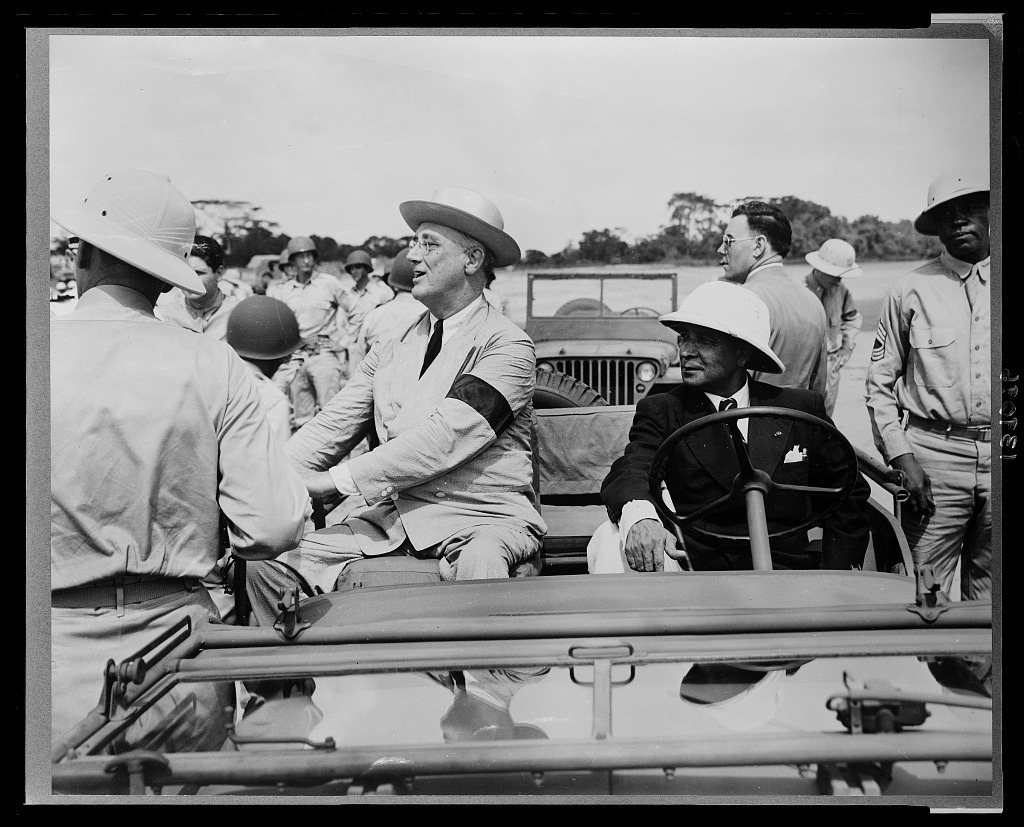
Memorial Day honours those who served in the armed forces of the United States. Most of that remembrance, rightly, looks to battlefields in Europe and the Pacific. But there is a quieter theatre of that war — on the West African coast, in the Republic of Liberia — whose contribution helped keep the Allied war machine moving, and whose story is woven directly into the lineage TABHI exists to preserve.
The rubber that the Allies could not lose
By the middle of 1942, the war in the Pacific had cut the Allies off from the rubber plantations of Southeast Asia. Natural rubber — essential for tyres, aircraft, and countless instruments of war — suddenly became one of the most strategically vital materials on earth. Apart from Ceylon (today Sri Lanka) and the Belgian Congo, one of the few remaining sources in Allied hands was the vast Firestone plantation at Harbel, Liberia, leased since 1926 and among the largest rubber operations in the world.
To secure that supply, the United States and Liberia signed a Defense Agreement in 1942. Under it, American forces and engineers came to build the infrastructure of a wartime ally: strategic roads into the interior, a deep-water harbour at Monrovia (the Freeport), and an airfield that would change the country's place in the world.
Roberts Field: a lifeline across the Atlantic
That airfield was Roberts Field — today Roberts International Airport, still Liberia's principal gateway. An advance U.S. Army construction force arrived in June 1942, and the base became a critical waypoint in the trans-Atlantic supply chain. Military supplies were gathered in Florida, routed through South America to Brazil, and flown across the ocean to the depot at Roberts Field, from which they continued onward to the North African campaigns in Morocco, Tunisia, and Algeria.
Crucially, the soldiers who built and ran this base were overwhelmingly African American. Thousands of Black U.S. troops were stationed in Liberia — constructing the airfield, maintaining the inventory, and staffing facilities such as the all-Black 25th Station Hospital. Among them was a young soldier named Ossie Davis, later one of America's most celebrated actors and civil-rights voices, who served at Robertsfield during the war.
Liberia's strategic importance was significant enough that, in January 1943, a sitting U.S. president crossed the Atlantic to stand on its soil.
A president's visit — and a Barbadian connection
Returning from the Casablanca Conference in January 1943, President Franklin D. Roosevelt stopped in Liberia, where he met President Edwin Barclay and reviewed the African American troops stationed there. The photograph above captures that moment. Roosevelt extended an invitation for Barclay to visit him in Washington — an invitation Barclay accepted, becoming one of the first heads of an African state received at the White House, in May 1943.
For TABHI, this history carries a particular resonance. President Edwin Barclay was himself a descendant of the very migration we document: his family came to Liberia from Barbados in 1865, part of the same post-emancipation movement that brought the Porte, Holder, Braithwaite, Eastman, and other families across the Atlantic. The man who welcomed an American president on Liberian soil, in the middle of a world war, shared the Barbadian-Liberian lineage that runs through this entire initiative.
What remains, and why we remember
The American military presence formally wound down after the war — U.S. forces withdrew in early 1946 — but the imprint remained. Roberts Field went on to host an emergency landing site for the U.S. Space Shuttle program and, for decades, the longest runway in Africa. Across Liberia, traces of this wartime infrastructure still stand.
This Memorial Day, we remember not only the American servicemen — many of them Black soldiers serving a country that did not yet treat them as equals — who built and staffed these installations far from home, but also the Liberian nation that stood with the Allies, and the descendants of Barbados who were part of that story. It is a thread of shared history between Barbados, Liberia, and the United States that deserves to be remembered.
Sources & further reading
- U.S. Library of Congress, photograph: "President Roosevelt and President Edwin Barclay of Liberia reviewing a detachment of American troops stationed in Liberia," 1943 (public domain).
- Encyclopædia Britannica, "Liberia: World War II and after."
- U.S. Department of State, Office of the Historian, Foreign Relations of the United States archives (Defense Agreement, 1942; Roberts Field records).
- Wikipedia, "Liberia in World War II" and "Roberts International Airport."
Editor's note: TABHI holds additional first-hand video and field documentation of military-related sites in Liberia connected to this history, gathered on the ground. Those materials will inform an expanded version of this account.